Key takeaway: The familiar EU rating ("Excellent", "Good", etc.) summarizes the past four bathing seasons, while a single laboratory sample is a snapshot in time. Checking both — together with the sampling date and recent weather — gives you the most reliable picture before heading to the lake.
"Can I Swim Here Today?" — One Question, Two Very Different Answers
Every summer, hundreds of thousands of people check the water quality of their local lake or beach before heading out. Often, the first thing they see is a reassuring label: "Excellent". But what does that classification actually measure — and does it still hold right after a heavy summer thunderstorm?
Germany monitors 2,143 official EU bathing waters. Making sense of their numbers comes down to distinguishing between the multi-year EU classification and the individual laboratory sample.
1. The EU Classification: A Four-Year Report Card
Under the EU Bathing Water Directive, sites are classified as Excellent, Good, Sufficient, or Poor. That grade is never based on a single water sample — it statistically aggregates microbiological test results from the previous four bathing seasons.
This makes it a strong indicator of long-term stability: whether a lake or river beach stays consistently clean across multiple years. By design, however, a four-year rating cannot reflect a sudden weather event from yesterday afternoon.
2. The Individual Sample: A Snapshot in Time
During bathing season, regional health and environmental authorities regularly collect water samples — typically at least once per month, and often more frequently. Laboratories measure two hygienic indicator bacteria:
- Escherichia coli (E. coli) — reported in colony-forming units per 100 milliliters (
CFU/100 ml, GermanKBE/100 ml) - Intestinal enterococci — also reported in
CFU/100 ml
While usually harmless themselves, these indicators reliably signal fecal contamination (for example from stormwater runoff, waterfowl, or combined sewer overflows) and the potential presence of pathogens.
Strandbad Wannsee in GewässerKompass
Looking at Berlin's Strandbad Wannsee shows how GewässerKompass keeps both perspectives clearly separated:
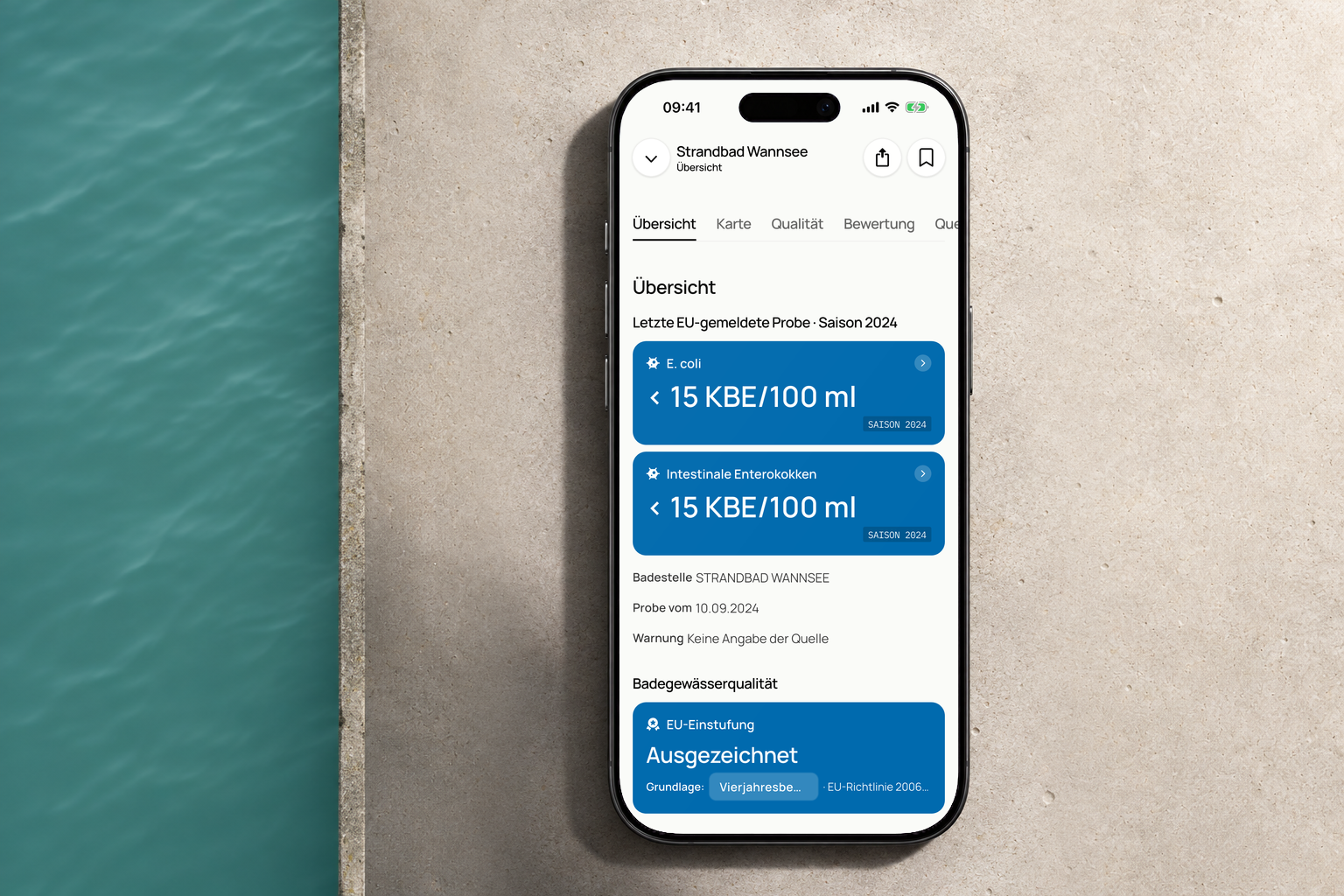
- EU classification: Excellent (four-year rating with its assessment year shown explicitly).
- Latest reported sample: Single sample showing
< 15 CFU/100 mlfor E. coli and< 15 CFU/100 mlfor intestinal enterococci along with its exact sampling date (source: European Environment Agency, EEA). - Built-in context note: Single readings are snapshots; heavy rainfall or algal blooms can change conditions at short notice. Official advisories and swimming bans appear whenever the responsible authority actively issues them.
Why the Sampling Date Matters So Much
In Germany, bathing water monitoring is managed by the 16 federal states — and not every state yet provides in-season samples through the same automated open feed:
- Where open state data feeds are already connected (such as Schleswig-Holstein and Hamburg), GewässerKompass refreshes in-season samples daily — including water temperature and, where provided, warnings and cyanobacteria notices.
- Where no live state feed is connected yet, the app uses the latest annual European Environment Agency (EEA) dataset and highlights the exact sampling date prominently so a previous season's measurement is never mistaken for today's reading.
Three Practical Habits Before Swimming
- Check the date: Look at both the four-year EU rating and the date of the most recent sample.
- Factor in recent weather: Heavy rain can temporarily wash pollutants into rivers and urban lakes.
- Watch for cyanobacteria (blue-green algae): During warm spells, greenish streaks, surface scum, or poor visibility in knee-deep water are a sign to skip swimming and follow local signage.
See all connected bathing water sources on our Data Sources page, in our documentation guide, or explore our guide on how Germany's rivers are rated under the EU WFD.